Micromigrations from The Atlantic on Vimeo.
I met Dennis at the University of Massachusetts Dartmouth this past summer at his Murmurations exhibition. Murmurations are the seemingly spontaneous synchronized swarm behavior of large groups of starlings. I witnessed visitors to the gallery stand together before the large projections, their shadows cast within the image, and respond synchronously both physically and with audible gasps of amazement. Clearly, something universal was occurring. Hlynsky's work evokes awe and wonder through beauty found in the here and now of invasive species and power lines. In speaking with him, it also struck me that Dennis was engaged on so many different levels with this work, and that he would have an interesting story to tell about taking positive steps along a path of inspiration and where this leads. He was so kind to agree to this interview.
First, I think we all wonder why and how these starlings are able to make this kind of movement. Do you know?
I don’t know. It is a question that’s often asked. I do suspect we humans are trying to find the answer to how starlings move in undulating black clouds by inspecting the cloud itself and the individual bird's navigation within the cloud. It is a very 20th century way of looking at the world. While that might solve part of the mystery, I don’t believe we can stop at the physics of flight to understand the dark cloud.
Personally I’m more interested in the seasonal changes to the “starling culture”--the social structures evident in how the birds move about while they are learning to fly in these large groups. While one can see smaller masses of starlings during other times of the year, fall to early spring is the main time they congregate in big numbers. While most of my recordings have been shot during this time I often wonder what the birds are doing during the late spring and summer.
What I think I know is this. They are borough dwellers, meaning they have their brood in the eaves of houses and hollows of trees. They are also monogamous. These nests have three to eight chicks and the family sticks together. They return to the same boroughs they were raised in to nest so there is a familial aspect to the sub-flocks. I imagine these sub-flocks are groups of lineage (DNA). Birds of a feather fly together but familial bonds remain a strong influence. These groups are usually what I look for and why I get excited.
Unlike sparrows these birds don’t fight. They’re quite good at giving space to another sub-flock. They share the wires. Often one bird will land and there is a chain reaction on the wires. Everybody moves down a bit to make room. In order to understand what is going on in pattern of flight, the social life of the flock needs to be recognized, I believe.
Starlings can live up to twenty years in captivity but in the wild that’s cut to two and a half. At the annual gathering many of the birds must be new to such large masses. While they look quite dark to us, starling vision extends to the ultra violet… think blacklight. To each other they are brightly colored. There is a seasonal shift in short wave UV in the fall and spring that may trigger these gatherings. So perhaps they can distinguish differences in coloring and age. There are so many unanswered questions.
At the end of it - I think they do it because they used to be dinosaurs and have genetically adapted to be able to fly together and it's fun for them. I believe they do it because they have a desire.
Have you ever noticed that a group of human viewers of your murmurations videos performs a similar kind of self-organized synchronized response-- a heart murmuration, if you will?
There are certainly times when we get together to feel the presence of each other in a crowd. We group together when attending events such as sports, concerts, and theater. I feel different when I’m in such a group. I believe humans are really good at making sense out of things that are marginal mysteries. Marginal mysteries… like two people saying the same thing at the same time. We can test for ESP (extra-sensory perception) but I don’t trust myself enough to believe the sense I am making isn’t nonsense. It’s possible birds that have had a longer evolutionary path might have developed a sixth or seventh sense. I do know they have unusual eyes and they chirp a lot.
Does the fact that starlings are an invasive species play a part in your thought process or inspiration?
English Sparrows and European Starlings are two species that are not indigenous to North America. There was a movement in the late 1800s to establish new habitats for birds by transplanting them. Sparrows were imported to control inchworms in New York City parks. It’s curious that the starling release was designed to introduce North America to all the birds mentioned in the works of Shakespeare. I am amazed at the ability of the starling species to adapt. Even a small elevation in seasonal temperatures will move the areas of habitation. Black Vultures, for example, are growing in number around Cape May due to an increase in seasonal temperatures.
While I could travel the world far and wide as a nature photographer – I tend to stay close to home. I’m not making these films to drive home a point about species invasion.
Evidence of human presence, such as power lines and traffic sounds, seems to play a deliberate role in Murmurations. What are your thoughts on, or experiences with, this?
When I first started shooting I worked to exclude everything but the movement of the starlings. I saw the power lines merely as graphic elements. I thought of them in very formal terms. As the project went on, the wires in the frame became a vignette of a much larger human communication system. The relationship between the lines of flight, the swarming intelligence of the starlings, and what the communication and power landlines represented grew. I started thinking more about the box stores, the ebb and flow of traffic, and started including perambulations of motorists.
For a while I investigated the lines themselves. Which ones carried power, which lines were there to defeat lightning strikes, which ones were used for cable communications and which ones were telephone. Some carry three phase and those lines have step down transformers. I started following groups of collectors of “glass pot heads” and insulators. My wife would yell at me to keep my eyes on the road when I drove. What I wanted to know was if the heat generated by the current through the wires and/or the electromagnetic field attracted the birds to sit on particular lines. I don’t see them landing on the overhead high voltage transmission lines.
Has the dissemination—over 7 million views or embeds—of your videos led to some interesting intersections with other communities or disciplines outside of video art?
It’s an interesting question. When YouTube and Vimeo became effective means of posting video, I sensed new video forms would follow. Clearly they have. In 2009 the evolution of social networks was the primary motivation for my uploading video experiments. For an artist interested in using their practice to create connections and exploratory conversations, posting for free is very appealing. While I don’t upload everything I make, I do tend to prize the conversation. So, I choose to upload and allow embedding of the video on blogs because I am more interested in creating social connections than in creating rarity.
Sharing of these files has introduced me to many notions related to these films. Among the groups who have engaged are folks from Geographic Information Science, typographers, scientists, birders, social biologists, microcellular biologists, skateboarders, dancers, and of course musicians. The sheer number of reposts puts me in touch with other artists who are doing similar work.
You are involved in a video project about patients with life-threatening illnesses. What is that about?
There is nothing more powerful than being in the presence of someone who is facing an uncertain future. We have made those conversations taboo. I believe that dialogue is necessary because it informs so many decisions. For me that time was a decade of evaluating what was important in life and what apparent gains were actual insignificant victories. That work taught me to be a patient participant in the world around me.
You have experienced dizzying technological advancement since you began digital image processing in 1983. What do you imagine is in store for the video artists of 2100?
I picked up my first video camera in 1972. What stood out to me then was that I could see myself for considerable lengths of time without looking in a mirror. That technical externalization of oneself was unheard of prior to the invention of the handheld video camera. Not totally unheard of, but it was very expensive and not common. The technology itself doesn’t interest me as much as the ideas that accompany the thing. Since the turn of the century we have embarked on a tremendous task. We have begun to compile and store vast amounts of data in video form. Coupled with the geographers and data visualizers I think we’ll see novel and evolving narrative forms.
As a culture we’ve become addicted to blogging, tweeting, uploading, geo-tagging, and time-stamping our recording of the world around us. We have become citizens that exhaust data, cells in a compound eye, working to compile recordings of what we ate, animals doing incredible things, unusual cars, family histories, natural events, skateboard tricks… the list goes on. This is mass activity new to the history of the world. Being able to slice and combine these tailings will become more and more interesting as we humans forget and the Internet does not.
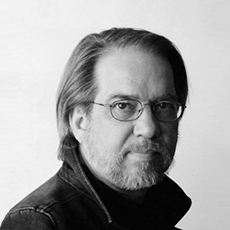 Dennis Hlynsky is a US-based artist and designer. With an insatiable desire to consider technology and its place in the arts, he came early to video and has more than 30 years of experience in the medium. He was among the first students in the RISD video program and is now a devoted teacher there. Since 1983 he has committed himself to the study of digital imaging processes and their accompanying ideas. He has received international recognition for his processed video of small animals moving en masse. These and other video works can be viewed at https://vimeo.com/user491023.